
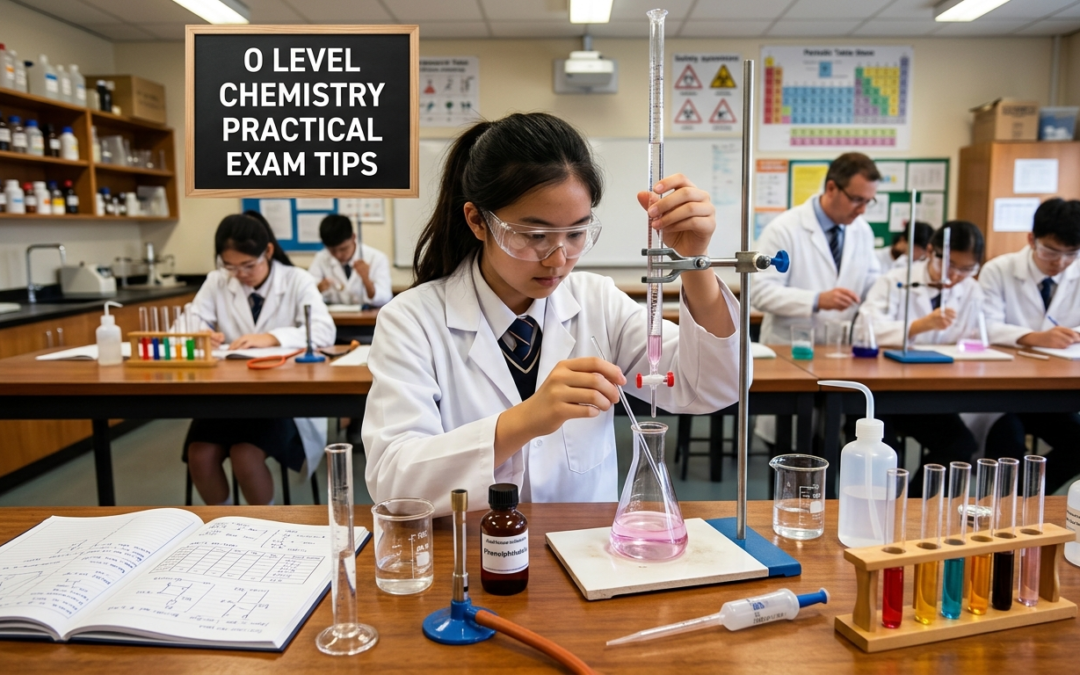
For 2026 Singapore-Cambridge O-Level C\hemistry exam, the practical paper (Paper 3) carries a weightage of 20% of the total grade for Pure Chemistry (6092). For Combined Science (Chemistry) students, the practical component (Paper 5) has a lower weightage of 15%.
For many students, the O Level Practical Chemistry Exam can be one of the most nerve-wracking components of the subject. Success in this paper isn’t just about memorizing facts, but about effectively applying concepts in a lab setting. From mastering planning questions chemistry to handling apparatus with precision, good preparation will make a world of difference. This guide covers essential chemistry practical exam tips, breaking down useful planning strategies, experimental techniques, and ways to avoid costly mistakes in your O Level practical chemistry exam.
Essential O Level Practical Chemistry Planning Tips
When approaching the planning questions chemistry section, clarity and structure are key. Start by carefully breaking down what the question requires—identify the variables, the aim of the experiment, and the resources available. Sketch a quick outline of your procedure before writing your final plan. This demonstrates that you can think logically and design a workable experiment, an important skill in O Level practical chemistry assessments.
Precision in planning involves predicting outcomes and recognizing potential difficulties. Include details such as measurements, control of variables, and methods to ensure accuracy. For example, if you’re asked to determine the concentration of a solution, note exactly how dilutions or titrations will be conducted. Examiners look for a well-thought-out sequence that reflects understanding, not just repetition of textbook steps.
Another valuable chemistry practical exam tip is to anticipate errors and mention how to minimise them. Always propose practical safety measures and ways to ensure reliability—such as repeating readings or washing apparatus thoroughly. This not only earns you additional marks but also shows a scientific mindset that examiners appreciate in well-prepared candidates.
Mastering Experimental Techniques and Accuracy Skills
Strong experimental techniques form the backbone of any successful chemistry practical. Handling apparatus correctly—like pipettes, burettes, and gas syringes—demonstrates confidence in the lab. Practice beforehand so that you can measure, mix, and record results efficiently under exam conditions. Remember that small details like avoiding air bubbles in titration, or rinsing equipment with the correct solution, often determine the difference between near-perfect and inconsistent results.
Accuracy in observation is equally vital. During quantitative practicals, take careful readings, and record all data systematically in a table with appropriate units. For qualitative experiments such as testing for ions or gases, describe observations clearly—terms like “effervescence,” “colorless gas,” or “white precipitate” are preferred over vague words like “fizzing” or “cloudy liquid.” These descriptive skills reveal attention to detail and understanding of chemical processes.
Manage your time well is also an important factor to doing well for the practical test/ exam. Divide your time wisely among experiments, recording results, and reviewing your answers. Avoid the temptation to rush through the planning stage—designing an efficient procedure first helps save time during execution. Accuracy is often the result of calm and methodical work, a hallmark of those who do well in O Level practical chemistry exams.
Avoiding Common Practical Mistakes in Chemistry Exams
One of the most overlooked chemistry practical exam tips is learning from others’ errors. Common practical mistakes include incorrect reading of meniscus levels, mixing up reagents, or forgetting to label test tubes. Always double-check your setup before starting and cross-verify each step against your plan. Small oversights can easily lead to large deviations in results, which could affect marks significantly.
Another frequent problem is the misuse of apparatus. For example, using an uncalibrated cylinder or applying excess heat can distort outcomes. Familiarize yourself with the limitations of each piece of equipment, and remember that sometimes the simplest tool can provide the most accurate data. Understanding why you use certain methods also helps you explain them clearly if questioned in the exam. And the fundamentals of using certain methods are also important.
Finally, be mindful of presentation. Untidy tables, missing units, or unclear observations send a message of poor preparation. Always label each experiment correctly, use neat handwriting, and highlight key findings logically. Examiners appreciate work that is organized, coherent, and scientifically sound—qualities that reflect strong preparation and awareness of common practical mistakes in chemistry examinations.
Your O Level practical chemistry paper is not just a test of knowledge—it’s an assessment of your ability to think, plan, and execute experiments scientifically. With consistent practice, attention to detail, and a clear understanding of planning and experimental techniques, you can perform confidently on exam day. Remember these chemistry practical exam tips as part of your overall revision plan, and you’ll be well-equipped to tackle even the most challenging practical questions with calm and precision.
At Habitat Learning Centre, we help students prepare through our Habitat Lab facilities. Although it is not a full-blown laboratory, the idea of a mock up run, the mental preparation is what we deemed more important as a student gets prepared for the practical test.
If you need help in Sec 4 Chemistry tuition, including the Chemistry practical paper, we are here to help. WhatsApp us at 97953323 to book a trial session now.
Recent Comments