Lower Secondary Science Tuition in Singapore
Expert Sec 1 & Sec 2 Biology, Chemistry & Physics Tuition | Novena
Best Science Tuition SG for Lower Sec (Sec 1 & 2)


75% Distinctions
2025 Combined Science Results
Max Class Size: 6
Personalised small-group learning
4.0 Avg Grade Jump
Proven track record & grade improvement
Since 2012
13+ years of trusted education
… My tutors always brought out the joy in learning be it for physics or chemistry for me. They would also always patiently explain whatever I did not understand and use real life examples to make it more understandable….
What Actually Changes When Your Child Moves from PSLE to Sec 1 Science
In primary school, science is one subject tested in one paper. From Sec 1 onwards, it becomes three — Biology, Chemistry and Physics — each taught in a different term, each with its own style of thinking and answering.
Most students are not told this clearly enough. They arrive in Sec 1 expecting science to feel like primary science. It doesn’t. The content is more abstract, the questions require more precise language, and the pace gives very little time to catch up if the first topic is lost.
Most tuition centres respond to this by offering separate Chemistry, Physics and Biology slots on separate days. We don’t. At Habitat, one lesson covers whichever of the three sciences your child’s school is testing that week. Before the first lesson, we ask which school your child attends and what topic their teacher is currently on. That is where we start.
This is not a small operational detail. It is the core reason students who join Habitat in Sec 1 tend to stay through to their O-Levels.
Book a trial lesson today or read on to find out what makes our lower secondary science tuition different. If you are also preparing for PSLE, check out our PSLE Science Tuition programme, headed by Ms Eunice Leong.
Our Tutors
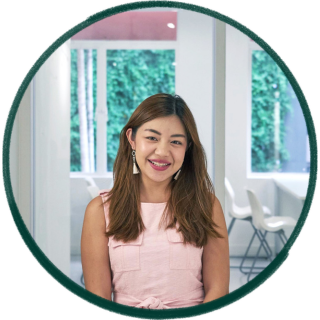
Ms. Eunice Leong
🎓 About Ms Eunice Leong – Lead Science Tutor, Lower Secondary
Ms Eunice Leong has been teaching lower secondary science at Habitat for over 10 years. She was top of her Physics and Mathematics cohort before university, and holds a Bachelor of Commerce (Economics and Finance).
What matters more than her credentials is this: she remembers exactly what it feels like to be a Sec 1 student facing three science subjects for the first time. She builds every lesson around that reality — not around a syllabus checklist.
Her classes are known for being direct and low-anxiety. Students ask questions they would not ask in school because they are not afraid of looking slow. That shift — from passive listener to active thinker — is usually what changes a student’s results.
“Good results come with hard work, discipline and consistency.” — Ms Eunice Leong
🔗 View Full Profile: Ms Eunice Leong – Lead Tutor at Habitat Learning Centre
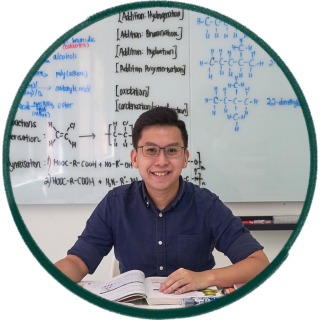
Ms. Leon Choo
🎓 About Mr. Leon Choo – Lead Tutor, Chemistry & Physics, Partner
Mr Leon Choo holds an NTU Bachelor of Science with Highest Distinction. He was an NTU Nanyang Scholar, CN Yang Research Programme Scholar, and NTU Dean’s Lister. Before teaching, he worked as a geologist — which is why when he explains thermal energy or chemical weathering, he is not describing something from a textbook. He has seen it.
His approach to lower secondary science focuses on one thing above all others: making sure a student understands why a phenomenon happens, not just what to write when asked about it. Students who grasp the reasoning behind a concept rarely lose marks on unfamiliar question types in exams.
View full tutor profiles on our About Us page.
What a Lesson at Habitat Actually Looks Like
Before the lesson
We find out what your child’s school has been teaching that week. If there is an upcoming test or weighted assessment, we find out the topic scope. The lesson is planned around this — not around where we happen to be in our own curriculum calendar.
During the lesson
Classes have a maximum of 6 students. This is not a marketing number — it means our tutor can ask every student a question at least once per lesson and notice immediately if someone does not follow. In a class of 15 or 20, a confused student can hide for weeks. In a class of 6, they cannot — and that is a good thing.
We use the K-D-C Framework that underpins all teaching at Habitat:
K
Knowledge
Concept mastery first
The student must be able to explain the concept back — not just recognise it. We do not move on until this is clear. This forms the foundation of learning.
D
Drill
Apply to varied question types
The student works through different question formats using the same concept, including unfamiliar ones they have not seen before.
C
Checks
Find and correct where marks are lost
We look at exactly where the student’s written answer loses marks and correct the answering pattern — not just the answer itself.
After the lesson
Students leave with a clear record of what was covered and what to review before the next session. Parents who want to know how their child performed can reach us directly — we do not make parents wait for a term report to find out their child has been struggling.
The Habitat Advantage: What Sets Us Apart
Curriculum-Aligned Teaching
Our tutors teach to your child’s school schedule, not a generic one. Whether your child’s school is testing Atomic Structure this week or Forces and Motion next week, our lesson plan adjusts accordingly. This is the single most effective way to improve exam scores in real time.
Our lead Chemistry tutor, Mr Leon Choo (NTU Bachelor of Science, Highest Distinction; NTU Nanyang Scholar; CN Yang Research Programme Scholar; NTU Dean’s Lister; former geologist), and Ms Eunice Leong (most liked lower secondary science tutor) are both fluent in Biology, Chemistry, and Physics. In a single lesson, they can pivot between subjects to match whatever your child needs most urgently — a rare and powerful edge over single-subject tutors.
Learn more about our tutors on our About Us page
Polymath Tutors Who Teach All 3 Sciences
Polymath Tutors Who Teach All 3 Sciences
Our lead science tutor, Mr Leon Choo (NTU Bachelor of Science, Highest Distinction; NTU Nanyang Scholar; CN Yang Research Programme Scholar; NTU Dean’s Lister; former geologist), is equally fluent in Biology, Chemistry, and Physics. In a single lesson, he can pivot between subjects to match whatever your child needs most urgently — a rare and powerful edge over single-subject tutors.
[Learn more about our tutors on our About Us page
Small Classes, Big Impact (Max 6 Students)
Every class at Habitat is capped at 6 students. This is not just a policy — it is a pedagogical commitment. Small classes mean our tutors notice when a student is lost before a grade suffers, can ask every student questions every session, and can tailor explanation depth to each learner in the room.
Science is not a collection of facts to be memorised — it is a way of thinking. Our tutors connect every concept to real-world phenomena. Thermal expansion becomes the reason your bottle cap pops off. Diffusion becomes the reason you can smell dinner from another room. When students understand the “why”, the “how to answer” follows naturally.
Beyond the Textbook: The "Why" Behind the Science
Beyond the Textbook: The "Why" Behind the Science
Science is not a collection of facts to be memorised — it is a way of thinking. Our tutors connect every concept to real-world phenomena. Thermal expansion becomes the reason your bottle cap pops off. Diffusion becomes the reason you can smell dinner from another room. When students understand the “why”, the “how to answer” follows naturally.
Our Results Speak for Themselves
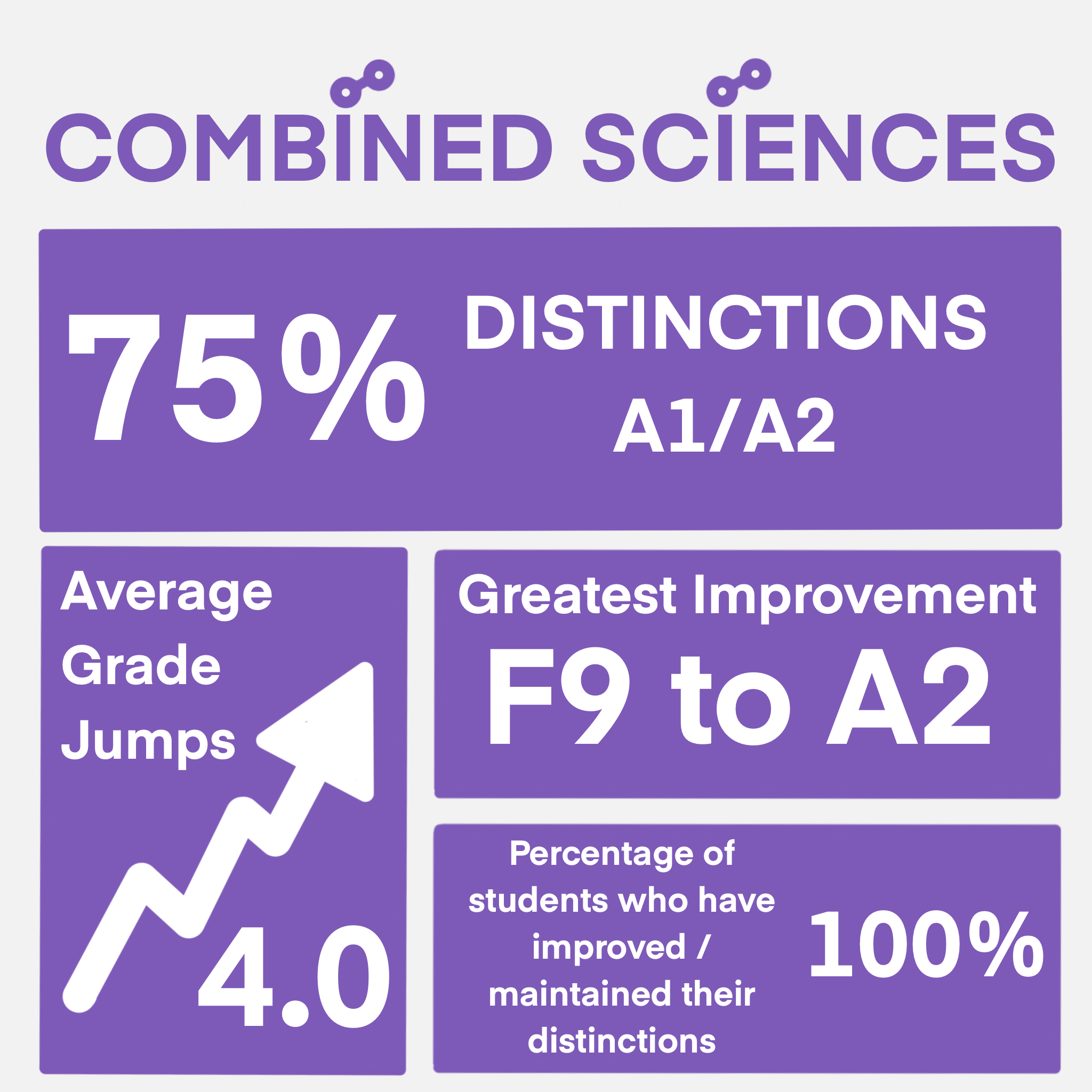
2025 O-Level Combined Science Results
- 75% of students achieved Distinctions (A1 / A2)
- Average grade jump across all students: 4.0 grades
- Greatest single improvement: F9 to A2
- 100% of students either improved or maintained a distinction grade
Many of our O-Level achievers began their journey with us during lower secondary science tuition in Sec 1 or Sec 2.
Student Testimonial
“I enjoyed my four years here very much. When I first came here, I did not think I would do well in secondary school. This is because I did badly for PSLE. However, after tuition here, I managed to score As for math and science in school. I must thank all the teachers who taught me well and made me understand topics better, especially my current physics and chemistry teachers.
I made very good memories here, and I enjoyed my time here very much”
Our Lower Secondary Science Programme
Sec 1 Science Tuition: Building the Right Habits Early
The most common mistake in Sec 1 is treating it like a continuation of primary school. It is not. The concepts are more abstract, the expected precision in answering is higher, and the three-subject workload arrives at the same time as CCA commitments and a new social environment.
What students need most in Sec 1 is not acceleration — it is orientation. They need to understand how secondary science questions are structured, what markers are looking for in a written answer, and how to manage three different subjects without letting one crowd out the others.
Our Sec 1 programme focuses on:
- Building a working understanding of Biology, Chemistry and Physics from the first term — not just familiarity
- Teaching students how to write answers that earn full marks, starting with the very first topic
- Aligning every lesson to what the school is currently teaching so nothing is wasted
- Showing students that science is logical and learnable — not a subject where you either “get it” or you don’t
Sec 2 Science Tuition: Preparing for a Decision That Matters
At the end of Sec 2, most students choose their O-Level science subjects. That decision is partly about interest and partly about confidence. A student who has only ever found Chemistry confusing will not choose Pure Chemistry in Sec 3, even if it might have suited them.
Our Sec 2 programme is built around removing that false ceiling. Students go deeper into all three sciences and learn how to handle application questions — the ones that take a familiar concept and present it in an unfamiliar context — that are increasingly common in Singapore science examinations.
By the end of Sec 2, our students typically have a clear and realistic sense of which sciences they are strongest in and which pathway — Pure or Combined Science — makes sense for them. We discuss this honestly with parents and students before the subject selection process begins.
Students who continue with us after Sec 2 move into our O-Level Chemistry Tuition and O-Level Physics Tuition programmes. Many have been with us continuously from Sec 1 to their O-Level results.
What We Cover — MOE Lower Secondary Science Syllabus
Lower secondary science in Singapore is taught in a modular structure. Schools typically focus on one discipline per term, rotating through Chemistry, Physics and Biology across Sec 1 and Sec 2. The order varies by school, which is exactly why we align to your child’s school rather than running a fixed sequence.
The tables below show the core topics we cover in each discipline, what the MOE syllabus requires students to know, and where we focus our teaching attention.
The challenge in lower secondary Physics is the formulas. Students often memorise them without understanding what they represent — and then cannot apply them when the question changes the context. We start every Physics topic by asking: what is this formula actually describing in the real world?
We also focus on the ability to apply the formulas to different scenarios. We also would draw relevant examples to the daily lives so students might find learning Physics more meaningful. Topics covered for Lower Secondary Physics include:
Physics Component: Energy & Matter in Motion
Focusing on mathematical precision and conceptual application.
| Core Topic | Key MOE Syllabus Concepts | Mastery Focus |
| Physical Quantities | Units, SI prefixes, and Measurement | Precision in Zero Error corrections and unit conversions. |
| Energy & Work | Kinetic, Potential, and Conservation of Energy | Solving multi-step energy transformation problems. |
| Thermal Energy | Conduction, Convection, and Radiation | Explaining heat transfer using the Particulate Nature of Matter. |
| Light & Sound | Reflection, Refraction, and Wave properties | Ray diagrams and calculating the speed of sound/echoes. |
*Please tilt to see table on mobile
Lower secondary Chemistry is the first time most students encounter things they cannot see — atoms, ions, molecules. The instinct is to memorise diagrams without understanding what they represent. We use visual models extensively so students can build a mental picture of what is happening at the particle level before we ask them to write about it.
At Habitat, our lower secondary chemistry tuition uses more diagrams. This helps students to see (and imagine) and grasp the images to better understand the concepts behind each topics. Topics covered in Lower Secondary Chemistry include:
Chemistry Component: The Nature of Matter
Focusing on symbolic representation and experimental techniques.
| Core Topic | Key MOE Syllabus Concepts | Mastery Focus |
| Exploring Matter | Atomic Model, Protons, Neutrons, Electrons | Drawing Atomic Structures and identifying isotopes. |
| Separation Techniques | Filtration, Distillation, Chromatography | Choosing the right technique based on physical properties. |
| Chemical Changes | Acids & Alkalis, pH scale, Indicators | Writing word equations and identifying Chemical vs Physical changes. |
| Particulate Nature | Diffusion, Expansion, and Contraction | Using the Kinetic Particle Theory to explain state changes. |
*Please tilt to see table on mobile
Biology at this level is heavily language-dependent. Markers are looking for specific terms used correctly in context. We teach students not just the content but the vocabulary of biology — so when they write an answer, they are using the same language the marking scheme uses. Topics covered in Lower Secondary Biology include:
Biology Component: Systems & Interactions
Focusing on specialized terminology and “Answering Techniques” for OEQs.
| Core Topic | Key MOE Syllabus Concepts | Mastery Focus |
| Cells & Organization | Cells: The Unit of Life, Specialized Cells | Comparing Plant vs Animal cells and levels of organization. |
| Human Systems | Digestive, Respiratory, and Circulatory Systems | Understanding Enzymes, absorption, and transport of nutrients. |
| Reproduction | Human Reproductive Systems and Puberty | Understanding the menstrual cycle and fertilization processes. |
| Ecosystems | Food Webs, Decomposers, and Conservation | Analyzing energy flow and human impact on Biodiversity. |
*Please tilt to see table on mobile
Students who excel in lower secondary science with us typically go on to take Chemistry Tuition and Physics Tuition with us at O Level. Many also pair science with our Lower Secondary Math Tuition for a well-rounded academic foundation.

How We Align to the MOE Science Framework
The MOE Lower Secondary Science framework puts scientific inquiry at the centre — the idea that students should learn to think like scientists, not just recall information like a database.
In practice this means our lessons are built around questions, not answers. We present a phenomenon, ask students what they think is happening and why, and then teach the underlying concept in response to their reasoning. Students who learn this way retain concepts far better than those who copy notes and memorise them.
Our notes and worksheets are built from the MOE syllabus. Nothing we teach is outside the exam scope and nothing within the exam scope is left uncovered.
How We Align to the MOE Science Framework
The MOE Lower Secondary Science framework puts scientific inquiry at the centre — the idea that students should learn to think like scientists, not just recall information like a database.
In practice this means our lessons are built around questions, not answers. We present a phenomenon, ask students what they think is happening and why, and then teach the underlying concept in response to their reasoning. Students who learn this way retain concepts far better than those who copy notes and memorise them.
Our notes and worksheets are built from the MOE syllabus. Nothing we teach is outside the exam scope and nothing within the exam scope is left uncovered.
Not Sure Where Your Child Stands? Start with a Diagnostic.
Before any student begins with us, we assess where they actually are — not where their school report suggests they are. Exam grades and genuine understanding often differ, especially in lower secondary science where students can memorise enough to pass without grasping the underlying concept.
For Upper Secondary students, we have also built the Habitat Aptitude Test (THAT) — a free online diagnostic used by over 2,400 students to identify exactly which Chemistry and Physics topics need attention before an exam.
Whether your child is in Sec 1 or Sec 4, we start by finding out what they actually know. Everything else follows from that.
Ready to Start? Book a Trial Lesson
Book Your Trial Lesson Today
WhatsApp us at +65 9795 3323 to reserve your child's spot.
Our trial lesson includes a diagnostic assessment so we can tailor the programme to your child's exact needs from day one.
FAQ About Science Tuition
What are the fees for lower secondary science tuition at Habitat Learning Centre?
We believe the best way to assess value is to experience our teaching first-hand. We invite all new students to a paid trial lesson, which includes a diagnostic assessment of their current level. After the trial, we discuss a tailored learning roadmap and fee structure. WhatsApp us to find out more.
When do Sec 1 and Sec 2 science tuition classes run?
We offer both weekday and weekend slots at our Novena centres. Class schedules vary by term. Please WhatsApp us or fill in the enquiry form below for current availability.
How does your tuition help with Open-Ended Questions (OEQs)?
Many students lose marks not because they don’t understand the concept, but because they don’t use the right keywords in their answers. We teach a structured Science Answering Technique — aligned with MOE and SEAB marking schemes — that trains students to write precise, mark-winning answers consistently.
Is this tuition suitable for students who are already doing well?
Absolutely. We serve students across all bands — from those needing foundational support to high-achievers targeting AL1 distinctions. For advanced students, we focus on eliminating careless errors, tackling non-standard application questions, and maximising every mark available.
My child is in Sec 1 and struggling to adjust — is it too early to enrol?
Not at all — in fact, the earlier the better. Habits formed in Sec 1 shape a student’s entire secondary science journey. Early intervention in the first term prevents the compounding gap that often leads to poor O-Level results three years later.
Where is Habitat Learning Centre located?
We have two outlets in Novena:
- Main Office: 1 Goldhill Plaza, #02-27, Singapore 308899
- Secondary Outlet: 183A Thomson Road, Singapore 307628 (opposite Velocity @ Novena Square via link bridge)
Both outlets are near Novena MRT, making us accessible from schools across the central region.
Let’s Learn Together!
Master Lower Secondary Science with Singapore’s Integrated Specialists Stop struggling with mismatched school schedules. Whether your child needs help with Physics, Chemistry, or Biology this week, our customized Lower Secondary Science tuition in Novena synchronizes perfectly with their school’s MOE syllabus. Help your child master complex Answering Techniques and bridge the gap to Upper Secondary success. WhatsApp us to book a trial session NOW!
We are located at 1 Goldhill Plaza, #02-27, Singapore 308899, right opposite United Square in Novena.
By MRT (Novena Station - NSL):
- Take Exit B and cross the overhead bridge linking Velocity to Goldhill Shopping Centre.
- Cut through the shops toward the distinctive round pink building (Goldhill Plaza).
- Walk up the staircase beside the carpark lift—we are located at #02-27.
Enquiry for Lower Secondary Science Tuition
Combined Sciences Summary:
- 75% Distinctions A1/A2
- Average Grade Jumps: 4.0
- Greatest Improvement: F9 to A2
- % of students who have improved/ maintained distinctions: 100%