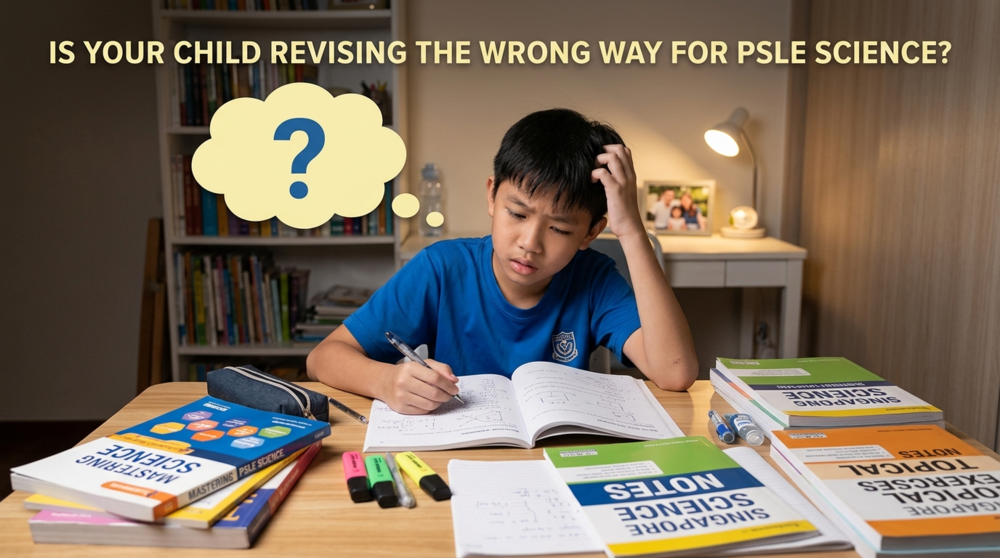
Is Your Child Revising the Wrong Way for PSLE Science?
By Ms Eunice Leong, Lead Tutor • Primary Science Department, Habitat Learning Centre
7-minute read • Written for parents of P5 and P6 students
Revision is happening. Your child is sitting at the desk every evening, working through assessment books, re-reading notes, doing practice papers. You can see the effort. And yet the scores are not moving.
If this sounds familiar, the problem is almost certainly not effort. It is method.
In over a decade of teaching Primary Science, one of the most consistent things Ms Eunice Leong sees is this: P6 or secondary students who revise diligently but revise in exactly the wrong way for what the PSLE Science paper, WA or O level paper actually tests. They work hard. They just work hard at the wrong things.
This article breaks down the five most common PSLE Science revision mistakes — and what to do instead.
Mistake #1: Treating Science Like a Memory Subject
The single most damaging revision habit is rereading notes and highlighting keywords as if PSLE Science is a memory test.
It is not.
The PSLE Science paper — particularly the Open-Ended Question (OEQ) section — tests your child’s ability to reason, apply, and explain. Examiners deliberately set questions using contexts your child has never seen before. A student who has memorised everything about photosynthesis but has never practised applying that knowledge to an unfamiliar scenario will freeze when the question presents it in a new way.
Passive revision — reading, highlighting, copying notes — creates an illusion of learning. Your child feels prepared because the content feels familiar. But familiarity is not the same as being able to use knowledge under exam conditions.
| What to do instead: Replace passive reading with active retrieval. Close the notes. Ask your child to explain a concept out loud without looking. Then ask them to write it down as if answering an OEQ. The moment they have to produce knowledge rather than recognise it, the real gaps become visible. |
Mistake #2: Doing Assessment Books Without Reviewing Mistakes
Assessment books are a staple of Singapore primary school revision — and they are useful. But how most students use them is almost completely backwards.
The typical pattern: attempt the questions, check the answers, circle the wrong ones, move on to the next set. The score goes in the margin. The mistake is never revisited.
This is revision theatre. It feels productive. It produces no learning.
The actual learning happens in the review — understanding precisely why a wrong answer was wrong, what concept was being tested, and what the correct answer structure looks like. Without this step, your child is simply practising their existing habits, including their existing mistakes, over and over.
| What to do instead: Spend as much time reviewing wrong answers as attempting new questions. For every OEQ answer that lost marks, ask: what keyword is missing? What part of the concept was not applied? What does a full-mark answer look like? Build a personal “mistake log” that tracks recurring errors — these patterns reveal the specific concepts that need attention. |
Mistake #3: Practising Answers Verbally Instead of in Writing
This is closely related to Mistake #1, but distinct enough to deserve its own section because it is so common.
Parents quiz their children at the dinner table. Teachers do verbal check-ins in class. Students explain concepts to each other out loud. All of this is valuable — but it does not prepare a student for the PSLE Science paper, because the paper requires written answers.
There is a significant gap between being able to say something correctly and being able to write it correctly in scientific language. Verbal answers are loose, conversational, and forgiven for imprecision. Written PSLE answers are marked against a specific marking scheme that rewards exact keywords, logical structure, and completeness.
A student who has only ever answered science questions verbally will consistently underperform in writing — not because they don’t understand, but because they have never trained the specific skill of written scientific expression.
| What to do instead: Make written practice non-negotiable. Every OEQ should be answered in writing, then compared against a marking scheme. Over time, students internalise the language and structure the examiner expects. This is one of the core skills we train in our PSLE Science tuition Singapore programme — because it is the skill that moves scores the fastest. |
Mistake #4: Ignoring MCQ and Focusing Only on OEQ
Open-Ended Questions carry significant marks and feel more urgent, so many students spend the bulk of their revision time on OEQ practice. The MCQ section gets a quick run-through the night before the exam.
This is a costly mistake. MCQ accounts for a large proportion of the PSLE Science paper marks — and PSLE MCQ questions are not straightforward. They are deliberately designed with attractive distractors: wrong answers that look correct to a student with surface-level understanding.
Students who have not specifically practised MCQ technique will consistently lose marks to these distractors — even on topics they know well. The difference between a student who scores 75% and one who scores 85% is often almost entirely in the MCQ section.
| ❌ How most students approach MCQ: Read the question quicklyPick the answer that sounds rightMove on This approach loses marks to distractors on almost every paper. | ✅ The trained approach: Identify the exact concept being testedEliminate clearly wrong options firstFor the remaining options, ask: which one is most precisely correct?Check: does the answer address every part of the question? |
Mistake #5: Revising Topics Equally Instead of Strategically
With limited time before the PSLE, many students revise every topic in order — working through their notes from Chapter 1 to the end. This feels thorough. But it treats every topic as equally important, equally likely to appear, and equally in need of work.
None of those things are true.
Some topics appear on almost every PSLE Science paper. Some topics are conceptually difficult and generate the most marks lost. Some topics your child already knows well. A strategic revision plan allocates time based on these factors — not based on which chapter comes first in the textbook.
Similarly, Experimental-Based Questions (EBQ) are consistently under-revised. Students find them unpredictable and spend their time on content topics instead. But EBQ questions follow recognisable patterns — fair test design, variable identification, data interpretation — and they are highly trainable once you know what to look for.
| What to do instead: Audit your child’s past papers and tests. Find the topics where marks are consistently lost. Prioritise those topics in revision. Then layer in EBQ practice as a separate skill, not as an afterthought. Time spent on known weaknesses returns far more marks than time spent polishing areas of existing strength. |
The Harder Truth About PSLE Science Revision
Here is what all five mistakes have in common: they feel like revision. Your child looks busy. Hours are being logged. But the activities are not aligned with what the PSLE Science paper actually rewards.
The paper rewards active application of concepts in writing. It rewards structured, keyword-precise answers. It rewards students who have practised the specific cognitive moves the exam requires — not students who have simply spent the most hours with their notes open.
This is not your child’s fault. Nobody tells them this explicitly. Schools teach content; they rarely teach exam technique as a deliberate skill. The assumption is that students who understand the content will naturally be able to express it well under exam conditions. That assumption is wrong, and it costs a lot of students a lot of marks every year.
| 💡 Ms Eunice’s note: “When a new student joins my class, one of the first things I do is ask them to attempt an OEQ question cold — no preparation, just write. The answer they produce tells me almost everything I need to know about their revision habits. Students who have been revising passively write vague, conversational answers. Students who have been practising written expression write structured, precise ones. The content knowledge is often identical. The technique is completely different.” — Ms Eunice Leong, Lead Tutor, Primary & Secondary Science, Habitat Learning Centre |
What a Good PSLE Science Revision Plan Actually Looks Like
To summarise everything above, here is what effective PSLE Science revision looks like in practice:
- Active retrieval over passive reading — explain concepts without notes, then write them down
- Written OEQ practice every session — not verbal, not mental, written and marked against a scheme
- Deep mistake review — every wrong answer is analysed, not just counted
- Dedicated MCQ technique practice — systematic elimination, not instinct
- Strategic topic prioritisation — more time on weak areas and EBQ, less on already-strong topics
- Consistent structured answering — using a repeatable OEQ framework until it is automatic
This is exactly the structure we follow in every session of our PSLE Science tuition programme at Habitat. Small classes of 4 to 6 students mean Ms Eunice can monitor each student’s revision habits, correct them in real time, and ensure every session builds the right skills — not just the appearance of them.
You may also find it useful to read our earlier article: Your Child Is Not Bad at Science. They Just Haven’t Been Taught This. — which explains the specific skill gap behind most PSLE Science underperformance.
The Bottom Line
Effort is not the problem. Method is.
If your P6 child is putting in hours of science revision but not seeing the results, the five mistakes above are the most likely culprits. The good news is that every single one of them is fixable — and fixing them does not require more hours. It requires better hours.
The PSLE is a specific exam with specific demands. Revising in a way that is aligned with those demands makes an enormous difference. And it is never too late to change approach.
| Want Ms Eunice to take over the revision strategy? Small classes. Structured technique. Real results. 📞 +65 9795 3323 ✉️ admin@habitatlearningcentre.com Enquire about PSLE Science Tuition → Explore more: PSLE Science Tuition • Science Tuition Singapore • About Ms Eunice Leong • Our Testimonials |
Recent Comments