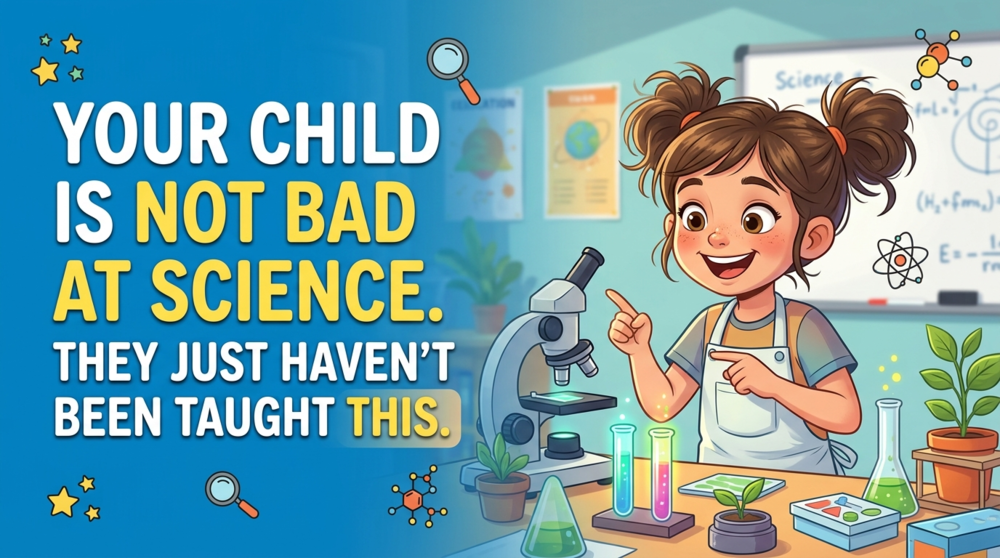
Your Child Is Not Bad at Science. They Just Haven’t Been Taught This.
By Ms Eunice Leong, Lead Tutor • Primary Science Department, Habitat Learning Centre
8-minute read • Written for parents of P5 and P6 students
It usually happens sometime in Primary 5 or 6.
Your child sits down with their science paper. They studied. You quizzed them the night before and they got almost everything right. But the marked script comes back and the score is nowhere near what it should be.
You look at the paper together. They can explain the answer out loud — clearly, correctly, confidently. But on paper, they wrote something vague. Incomplete. Missing the exact words the examiner was looking for.
And you think: what is going on?
Here is what is going on: your child is not bad at science. They are simply missing one specific skill that almost no school in Singapore explicitly teaches — and without it, even a student who fully understands the content will consistently underperform on the PSLE Science paper.
That skill is structured scientific expression. And once you understand what it is, everything starts to make sense.
The PSLE Science Paper Does Not Just Test What Your Child Knows
Most parents — and honestly, many students — treat science revision as a content exercise. Learn the concept. Memorise the keywords. Understand how a circuit works, or why plants need sunlight, or what happens during the water cycle.
That is all necessary. But it is only half the battle.
The PSLE Science paper, particularly the Open-Ended Question (OEQ) section, does not simply ask your child what they know. It asks them to construct a scientific argument — to observe, to reason, to connect cause and effect, and then to express all of that in precise, examiner-approved language under time pressure.
This is a fundamentally different skill from understanding. And it is one that needs to be deliberately trained.
Here is a real example of the gap:
| ❌ What a student thinks is a good answer: | ✅ What the examiner is looking for: |
| “The plant grew taller because it had more light.” | “Plant A received more light energy for photosynthesis, allowing it to produce more food for growth. As a result, Plant A grew taller than Plant B.” |
| The student understands the concept. But this answer would score 0 or 1 out of 3 in most PSLE marking schemes. | Same understanding. Completely different score. The difference is structured scientific expression. |
Why School Lessons Don’t Plug This Gap
It is not a criticism of schools. Primary school science teachers are covering a full syllabus across a large class. Their job is to ensure students understand the content — and most do a good job of that.
But here is the reality of a 40-student classroom: there is simply not enough time for a teacher to sit with each student, read their OEQ draft, and show them exactly where their phrasing fell short and why. That kind of individual feedback loop — attempt, correct, attempt again — is what builds the skill of structured scientific expression. And it almost never happens at the class level.
So students go home having understood the lesson. They revise the content. They can answer questions verbally. But they have never been trained to translate that understanding into the precise written form the PSLE examiner rewards.
This is the gap. And it is far more common than most parents realise.
What Structured Scientific Expression Actually Looks Like
When we work with students at Habitat, one of the first things we do is introduce a consistent OEQ answering framework that they practise until it becomes instinctive. It has five components:
| The 5-Part OEQ Framework | Why this works |
| 1. Identify — What is the question actually asking? 2. Link — Which concept or keyword applies here? 3. Apply — State the concept using PSLE-standard scientific language 4. Evidence — Use data or observations from the question 5. Conclude — Close with a logical, complete statement | Most students write what they think — a loose, conversational answer that conveys the right idea but misses the scientific precision the examiner is marking against. This framework gives students a reliable mental checklist they can run through under exam pressure. Over time, it becomes automatic. Students stop guessing what to write. They stop running out of things to say. They stop leaving marks on the table simply because they expressed a correct idea in the wrong way. |
And It’s Not Just the Open-Ended Questions
Many parents focus only on OEQ because it is where the longer answers go. But the MCQ section of the PSLE Science paper is also specifically designed to catch students who understand concepts superficially.
PSLE MCQ options are crafted to be plausible. The wrong answers are not obviously wrong — they are wrong in subtle, conceptually meaningful ways. A student who has memorised content but not deeply understood it will consistently pick the attractive distractor rather than the correct option.
Training for MCQ is also a skill. It involves learning to read the question precisely, eliminate options systematically, and identify the specific concept being tested — not just the topic area.
This is another area where deliberate, guided practice makes a measurable difference — and where students who have only revised at home with assessment books are consistently underprepared.
The Mindset Shift That Changes Everything
Once parents understand that PSLE Science is a skill-based paper — not just a content-based one — everything about how they support their child’s revision changes.
Buying more assessment books is not the answer. Watching more YouTube videos explaining photosynthesis is not the answer. Quizzing them on facts the night before is not the answer.
The answer is deliberate practice of the specific skills the paper tests: structured written expression, systematic MCQ elimination, experimental question analysis, and time management under exam conditions.
These skills can be taught. They can be practised. And with the right guidance, they can be developed in a matter of weeks — even for students who are already in Primary 6.
| 💡 A note from Ms Eunice Leong: “Every year, I see students who come to me convinced they are ‘just not a science person’. Within a few sessions, once they understand what the paper is actually asking them to do and learn how to answer it properly, their confidence transforms. It is not magic. It is the right technique, practised consistently. Science was never the problem.” |
Signs Your P6 Child May Have This Gap
Ask yourself whether any of these sound familiar:
- They can explain science concepts out loud but write vague, incomplete answers on paper
- Their MCQ scores are inconsistent — sometimes good, sometimes poor — for no obvious reason
- They run out of things to write in OEQ even when they know the topic
- They lose marks on questions where you can see they understood the concept
- They find experimental-based questions (EBQ) particularly confusing or unpredictable
- Their school test scores do not reflect how well they seem to understand the content at home
If two or more of these resonate, the gap is almost certainly one of expression and technique — not knowledge. And that is the most solvable kind of problem.
What You Can Do About It
There are a few practical steps you can take immediately:
1. Stop marking answers as “wrong” and start asking “why”
When your child gets a question wrong, resist the instinct to tell them the right answer. Instead, ask them to explain their reasoning out loud. You will quickly discover whether the problem is a conceptual gap or an expression gap — and they are very different things requiring very different fixes.
2. Practice OEQ answers in writing, not just verbally
The single most useful thing you can do at home is ask your child to write out their science answers — not say them. Then compare their written answer against the marking scheme. Look at where the marks are allocated and what specific language the marking scheme uses. This is the fastest way to expose the expression gap.
3. Get structured guidance on answering technique
If the gap is significant, or if PSLE is approaching and there is not much time, structured tuition focused specifically on technique will close the gap faster than self-revision. Our PSLE Science tuition Singapore programme at Habitat is built around exactly this — the OEQ framework, MCQ technique, and EBQ analysis that the paper tests. Small classes of 4 to 6 students mean Ms Eunice can give every student the individual feedback that makes the difference.
The Bottom Line
Your child is not bad at science. They are bright, they work hard, and they understand more than their paper scores suggest.
What they are missing is a specific, teachable set of skills that the PSLE Science paper rewards — skills that are rarely taught explicitly in school, and that make an enormous difference once a student has them.
The earlier this gap is identified and addressed, the more time your child has to build confidence and consistency before the exam. But even for students already in Primary 6, it is absolutely not too late.
If you would like to find out more about how we approach this at Habitat, you can read about our PSLE Science tuition programme, or reach out to us directly. We are happy to have an honest conversation about where your child is and what they need.
| Is your child ready for PSLE Science? Small classes. Proven technique. Headed by Ms Eunice Leong. 📞 +65 9795 3323 ✉️ admin@habitatlearningcentre.com Enquire about PSLE Science Tuition → Explore more: Science Tuition Singapore • About Ms Eunice Leong • Our Testimonials |
Further reading:
Recent Comments