Empower Your Child to Excel in PSLE Science
Comprehensive PSLE Science Tuition in Singapore
Build Real Understanding. Master the PSLE Science Paper. Score with Confidence.
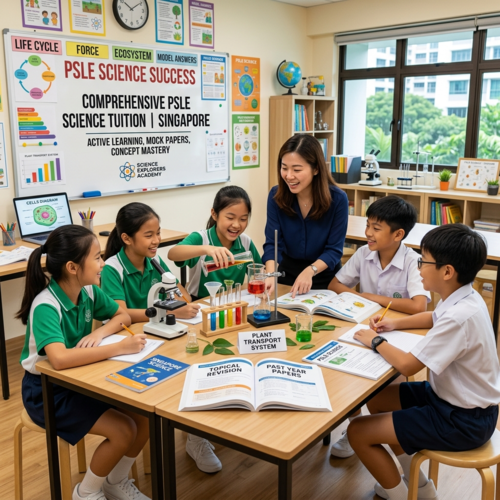
Is Your P6 Child Ready for the PSLE Science Paper?
The PSLE Science paper has evolved significantly. Gone are the days when memorising facts was enough — today’s examiners reward students who can think, reason, and apply scientific concepts to unfamiliar situations. Open-Ended Questions (OEQ) now demand structured, evidence-based answers that many students are simply not trained for in school.
At Habitat Learning Centre, we understand the unique demands of the PSLE Science paper. That is why we have launched a dedicated primary science programme — part of our broader science tuition Singapore offering — headed by our experienced lead tutor Ms Eunice Leong, to give your P6 child the focused preparation they need to excel.
Some articles to help you navigate your child’s learning challenges:
- Not sure if your child really has a science problem? Read: Your Child Is Not Bad at Science. They Just Haven’t Been Taught This.
- Struggling with revision? Read: Is Your Child Revising the Wrong Way for PSLE Science?
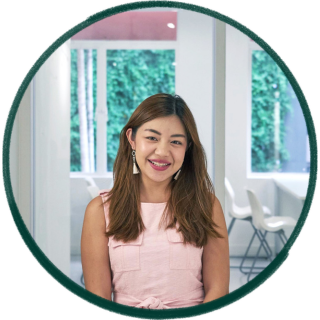
Ms. Eunice Leong
🎓 About Ms Eunice Leong – Lead Tutor, Primary Science Department
Ms Eunice Leong is a partner and lead tutor at Habitat Learning Centre with over 10 years of teaching experience in Science and Mathematics. Known for her bubbly personality and innovative teaching methods, she has consistently helped students achieve outstanding results through engagement, encouragement, and disciplined revision.
As the saying she lives by goes: “Good results come with hard work, discipline and consistency.” Ms Eunice was top of her Physics and Mathematics cohort prior to university, and holds a Bachelor of Commerce (Economics and Finance). She brings the same systematic rigour to her PSLE Science classes as she does to her secondary and upper secondary programmes.
Her ability to foster genuine connections with students means her classes are always engaging — and her track record across the past decade speaks for itself.
🔗 View Full Profile: Ms Eunice Leong – Lead Tutor at Habitat Learning Centre
Why PSLE Science Is Harder Than Ever
Many parents are surprised to find that their child, who seemed to manage science in Primary 4 or 5, suddenly struggles in Primary 6. The PSLE Science paper tests higher-order thinking and the ability to construct well-reasoned answers — skills that require deliberate training.
Furthermore, the inclusion of data analysis and interpretation tasks in the PSLE Science paper has increased the difficulty level. Students are expected to analyze graphs, tables, and experimental results, drawing logical conclusions based on evidence. This shift underscores the importance of developing a comprehensive understanding of scientific inquiry and the ability to apply this knowledge in diverse contexts.
Here are the key challenges P6 students face:
-
- Open-Ended Questions (OEQ) require structured, keyword-rich responses that are very different from school homework
- MCQ options are deliberately tricky, designed to expose weak conceptual understanding
- Topics like Energy, Forces, and Ecosystems require application across different scenarios, not just recall
- Time pressure in the actual PSLE paper catches unprepared students off guard
- Students who studied well for SA2 in P5 may find P6 concepts significantly more demanding
Our Unique K-D-C Teaching Approach
Our PSLE Science Teaching Approach at Habitat
Our PSLE Science programme is built on the same K-D-C Framework that has driven results across our secondary Science, Chemistry, and Physics programmes — now tailored for the MOE Primary Science syllabus and PSLE examination format.
K
Knowledge
We build deep conceptual clarity across all PSLE topics. Students learn the ‘why’ behind every concept, not just the ‘what’. This is the foundation that prevents common MCQ traps.
D
Development
Students are trained to apply concepts to novel scenarios through guided practice with past-year PSLE papers and proprietary question sets. Emphasis is placed on answering technique and keyword usage.
C
Checks
Regular mini-assessments track progress and close learning gaps before they compound. Parents receive feedback so the home learning environment can reinforce classroom learning.
Our OEQ Answer Framework
A structured approach for Open-Ended Questions that examiners reward:
- Identify: What is the question really asking?
- Link: Which concept applies here?
- Apply: State the concept using PSLE-standard scientific keywords
- Evidence: Use data or observations from the question
- Conclude: Give a complete, logical answer
This framework is practised until it becomes second nature, reducing exam anxiety and improving consistency.
One Subject. Three Sciences
What Our PSLE Science Tuition Covers
Our programme follows the MOE PSLE Science syllabus comprehensively. Every topic is taught with a focus on both conceptual understanding and exam application. In general, there are 5 topics covered.
Systems & Cycles
-
- Respiratory System
- Circulatory System
- Digestive System
- Reproductive System
- Plant System
- Water Cycle
- The Cell
Energy
-
- Forms and Uses of Energy
- Energy Conversion
- Photosynthesis
- Heat and Temperature
- Light
- Electricity and Circuits
Interactions
-
- Forces – Gravitational, Frictional, Elastic Spring, Magnetic
- Interaction of Forces
- Food Chains and Food Webs
- Living Together (Adaptations)
- Man’s Impact on the Environment
Diversity & Matter
-
- Diversity of Living Things
- Diversity of Materials
- Changes in Matter
- States of Matter
- Magnets
Process Skills
-
- Experimental-Based Questions (EBQ) techniques
- Data interpretation and analysis
- Variable identification (independent, dependent, constant)
Why Choose Habitat Learning Centre?
Discover the Benefits of Our PSLE Science Tuition
What Makes Habitat Different
Why Choose Habitat Learning Centre for PSLE Science Tuition?
✅ Small Class Sizes (4–6 students)
Every student receives focused attention. Ms Eunice knows each student’s learning gaps and adjusts accordingly.
✅ Experienced Science Specialist
Over 10 years of dedicated science teaching experience, with a proven track record at both primary and secondary level.
✅ MOE-Aligned Curriculum
Every lesson maps directly to the MOE PSLE Science syllabus, the school’s curriculum, and the examiner expectations.
✅ Structured Answering Techniques
We train students in proven OEQ and MCQ techniques, not just content knowledge.
✅ Regular Progress Updates
Parents are kept in the loop so that study habits at home reinforce what is learnt in class.
✅ Conducive Learning Environment
Our Novena centre is designed to be a second home for students — comfortable, focused, and motivating.
Class Structure & Schedule
Our PSLE Science programme runs in small groups of 4 to 6 students, ensuring every student is seen and supported. It sits within our wider science tuition programme at Habitat, which spans Primary through to JC level. Each session is 1.5 to 2 hours, structured as follows:
-
- Concept Review: Consolidation of current topic with misconception correction
- Worked Examples: Teacher-led walkthrough of PSLE-standard questions with annotations
- Guided Practice: Students attempt questions independently, with support as needed
- Answering Technique Drill: Focus on OEQ phrasing, keyword use, and structure
- Homework Review: Common errors from the previous week are addressed
Classes are available on weekday evenings and weekends at our Novena centre. Online options are also available for students who prefer home-based learning.
📌 Location: Habitat Learning Centre, Novena, Singapore — Get Directions
Frequently Asked Questions About Our PSLE Science Tuition
Choosing the right tuition for your child is crucial. Here are answers to some frequently asked questions to help you make an informed decision.
Is it too late to start PSLE Science tuition in Primary 6?
Not at all. Primary 6 is the most impactful time to start, because all the foundational concepts from P3 to P5 are still fresh. A structured programme focused on answering techniques, common misconceptions, and exam strategy can produce significant improvement in a short time — especially with the structured guidance that small-class tuition at Habitat provides.
My child understands the content but cannot write good OEQ answers. Can you help?
Yes — this is one of the most common situations we see. Understanding content and expressing it in examinable form are two different skills. Our OEQ answering framework and regular guided practice sessions are specifically designed to bridge this gap.
What is the difference between Habitat’s PSLE Science tuition and school lessons?
School lessons focus on curriculum delivery across the whole class. Our tuition focuses on your specific child — their misconceptions, their gaps, their answering habits. With a class of 4 to 6 students, Ms Eunice can identify and address individual issues far more quickly and effectively than is possible in a school classroom setting.
Does Habitat offer online PSLE Science tuition?
Yes. We offer both in-person classes at our Novena centre and online tuition options for families who prefer the flexibility of home-based learning. Quality and class size remain the same for both formats.
My child is in Primary 5 — should I start now or wait until P6?
Starting in P5 gives your child a valuable headstart. The P5 Science syllabus lays critical groundwork for PSLE topics, and students who build strong habits and scientific thinking in P5 find P6 significantly more manageable. Early enrolment also means your child has more time to internalise answering techniques rather than rushing to learn them under PSLE pressure.
What topics are most important for PSLE Science?
All topics can appear on the PSLE paper, but high-frequency areas include Forces and Interaction of Forces, Energy Conversion, Photosynthesis, the Respiratory and Circulatory Systems, and Experimental-Based Questions (EBQ). We ensure comprehensive coverage of the full MOE Primary Science syllabus while dedicating extra attention to these higher-weightage areas.
What Comes After PSLE Science?
Once your child clears the PSLE, the transition to secondary school brings an entirely new science landscape — Physics, Chemistry, and Biology taught as separate subjects. Students who have built strong scientific thinking at primary level make this jump far more smoothly.
Habitat’s lower secondary science tuition programme is designed to bridge exactly this gap — giving students a confident start in Sec 1 and Sec 2 before the subjects diverge further in upper secondary.
Ready for your PSLE Exams?
PSLE Science Success starts now. Give your child the edge they need to tackle complex open-ended questions with confidence. Unlock their potential at Habitat.
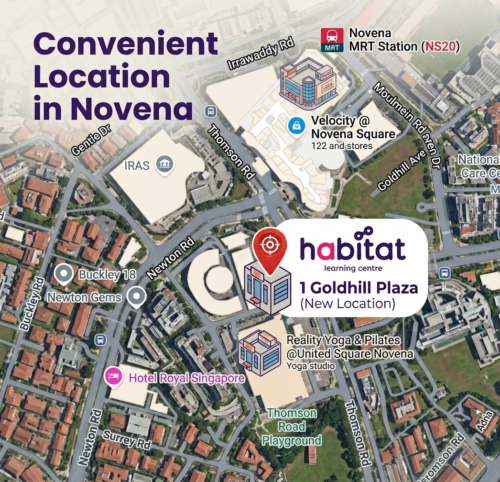
We are located at 1 Goldhill Plaza, #02-27, Singapore 308899, right opposite United Square in Novena.
By MRT (Novena Station - NSL):
- Take Exit B and cross the overhead bridge linking Velocity to Goldhill Shopping Centre.
- Cut through the shops toward the distinctive round pink building (Goldhill Plaza).
- Walk up the staircase beside the carpark lift—we are located at #02-27.