Primary Math Tuition Singapore
Small Class Primary Math Tuition (P1-P6 and PSLE)


… The other aspect of why we chose habitat was their teaching methodology…. every student is coached individually… The tutor will coach each of them individually based on their school’s curriculum. So, the learning is uniquely relevant to the child. U have to pay them a visit to really understand this part. 🙂
Primary Math Tuition in Novena | P 1 – P6 & PSLE | Habitat Learning Centre
P 1 – P 6 & PSLE
If you are looking for primary math tuition in Singapore, At Habitat Learning Centre, our primary maths tutor offers structured, small-group mathematics coaching for Primary 1 through Primary 6 students, including dedicated PSLE preparation for P5 and P6. This page covers our primary maths programme specifically. For an overview of all our maths programmes from primary through JC, see our full range of math tuition in Singapore.
Primary mathematics in Singapore is more demanding than it looks. The MOE syllabus builds progressively from foundational number sense in P1 through to fractions, percentages, ratio, and — from 2026 — introductory algebra at P6. By the time students sit the PSLE, they are expected to solve complex, multi-step problem sums using a range of heuristic strategies, often under significant time pressure. Many students who keep up through P3 begin to fall behind in P4 and P5 when topics become more abstract and problem sums become harder to solve by intuition alone.
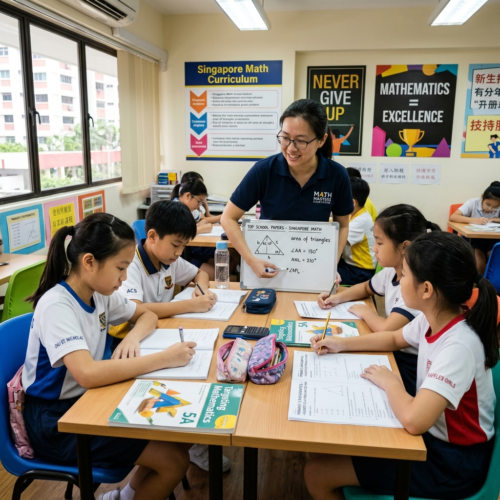
At Habitat, our primary maths tuition classes follow the same principles that have produced results across our secondary and JC programmes: classes capped at 6 students, a diagnostic aptitude test before the first lesson, in-house teaching materials aligned to the current MOE syllabus, and teachers who stay with their students consistently. Every session follows our K-D-C framework — Knowledge, Drill, Checks — so students understand concepts before practising them, and every student’s working is reviewed individually every class.
→ WhatsApp us on +65 9795 3323 to check P 1 – P6 class availability or arrange a trial
Why Primary Maths Gets Harder — and Where Students Fall Behind
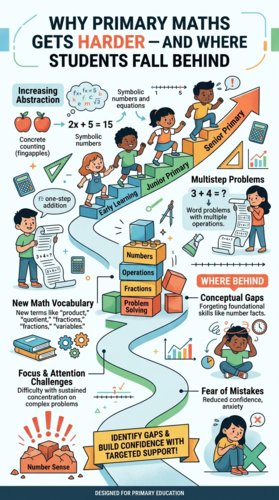
Singapore’s primary mathematics curriculum is internationally recognised for its rigour. The approach — known as Singapore Maths — builds mathematical thinking systematically through the Concrete-Pictorial-Abstract (CPA) framework: students first handle physical objects, then represent them visually, and finally work with abstract symbols. This progression is effective but demanding, and the difficulty ramps up significantly from P4 onwards.
Lower primary (P1–P3): building number sense and operations
P1 to P3 introduce whole numbers, the four operations, fractions, basic measurement, and geometry. Topics at this stage feel manageable for most students, but the habits formed here — particularly the habit of showing working step-by-step and checking answers — determine how well students cope when questions become harder. Students who rush through lower primary work with a focus on getting the right answer, without showing their reasoning clearly, frequently struggle when P5 and P6 problem sums require multi-step working that must be communicated to the examiner.
Upper primary (P4–P5): the difficulty jump most parents underestimate
P4 introduces decimals, pie charts, nets, and angles — topics that require spatial reasoning and proportional thinking that many students find genuinely difficult. P5 introduces fractions in more complex forms, percentages, area and volume of composite figures, and data analysis. This is the point where a significant number of students who were doing well in lower primary begin to struggle. The problem sums in P5 are materially harder than anything in P3 or P4 — they are longer, involve more steps, and require students to identify which heuristic strategy applies before they can even begin solving.
P6 and PSLE: the 2026 updated syllabus
2026 is a landmark year for primary mathematics in Singapore. For the first time, all P1 to P6 students are on the fully updated MOE syllabus. For P6 students, this means several significant changes:
- Algebra is newly introduced at P6 — students now encounter simple linear equations (e.g. 3x + 5 = 20) and algebraic expressions as part of the PSLE syllabus
- Ratio and Average have moved from P5 to P6, meaning these topics are tested for the first time in the PSLE under the updated syllabus
- Speed has been removed from the primary syllabus entirely and moved to Secondary 1
- Pie charts and nets were moved down to P4, which is already reflected in current P4 teaching
The 2026 PSLE Mathematics paper itself has also been updated. Paper 1 now carries 50 marks (up from 45) and Paper 2 carries 50 marks (down from 55), making both papers equally weighted. Paper 1 has more multiple-choice questions; Paper 2 has fewer structured questions. Total duration remains 2 hours 30 minutes. Our teaching materials and exam preparation are fully updated to reflect these 2026 changes.
How We Teach Primary Maths at Habitat
Proven teaching method and track record of results
Every Habitat primary maths class follows our K-D-C framework — the same methodology used across our secondary and JC programmes, adapted for primary level:
-
- Knowledge — we ensure genuine conceptual understanding before practice begins. For primary maths, this means making sure students can explain why a method works — not just apply it mechanically. A student who understands why the model method represents a fraction can adapt it to an unfamiliar problem sum. One who has only memorised the drawing procedure cannot.
- Drill — structured practice at progressively increasing difficulty. We begin with straightforward questions to confirm the concept, then move through graduated difficulty toward PSLE-standard problem sums. This deliberate progression builds both accuracy and the confidence to attempt harder questions without freezing.
- Check — every student’s working is reviewed individually every session. At primary level, this includes checking whether students are setting out their model drawings clearly, labelling their working, and showing sufficient steps to earn method marks in Paper 2.
This approach produces consistent improvements. Students who arrive struggling with problem sums regularly achieve significant grade improvements within a term. Beyond results, students develop a more confident approach to mathematics — the willingness to attempt unfamiliar questions rather than leaving them blank.
Every topic begins with genuine conceptual understanding. We explain where a formula comes from, what it represents, and when it applies. A student who understands why the quadratic formula works can reconstruct it under pressure. A student who has only memorised it cannot.
All newly enrolled students will sit for Habitat’s foundation check test. This allows our teacher to identify students’ weaknesses and provide necessary guidance during the coaching session.
Drilling is speed focus and getting familiar with the type of questions in a particular topic. Once the concept is secure, we move to structured practice. We start with straightforward, confidence-building questions and progressively increase difficulty toward examination standard. This gradual exposure prevents the anxiety of being thrown at hard questions before students are ready — while still ensuring they can handle exam-level difficulty when it counts. Students are trained to identify keywords and look out for what kind of answer the question is asking for. Keyword identification is one of the most important factor to do well in math.
We hand out worksheets to the students for practice. These worksheets compile questions from various resources and are also sub-grouped by levels of difficulty. Students may start with the basic questions before attempting the level-3 most challenging ones as they progress.
We would drill the students with questions and thinking speed so that when they look at certain question, they could identify them with questions they have worked on before.
When it comes to tests and exams, being familiar with questions is key and this would increase their confidence in tackling any question. We want them to think, even before attempting the test or exam question, “Hey, I have seen this before. I can do it!”
We probably heard countless times a student said, ”Aiya, it was a careless mistake!”. While we try to be perfect, there would be times we would still make mistakes.
The derived answer for a question has to pass the first check – logical check. Sometimes students may make certain careless mistakes thus deriving at a wrong answer; even when they could be fundamentally sound with the concepts. Certain answer will “look” strange for example having answers with decimals places instead of whole numbers to solve an equation.
When a student is drilled well enough, they will be able to get telltale signs of a mistake and amend their workings accordingly to derive the correct answer.
There are 2 sides to an equation. Deeper checks will be substituting a variable into the equation to see if the result is consistent. Our teachers will guide our students on such checks.
When a student goes through drill and checks, with time, they will also have a better grasp of the key concepts. This helps them to affirm their understanding of a particular concept and gain more confidence.
As success breeds success, our students will definitely get better with math in no time, and scoring for math would be natural.
Model method and heuristics — taught systematically, not by rote
The Singapore Maths model method — drawing bar models to represent relationships between quantities — is one of the most effective problem-solving tools in primary mathematics. Most students are introduced to it in school, but many use it inconsistently or only for problem types they have specifically practised. At Habitat, we teach the model method as a general reasoning tool, not a template to be copied. Students learn to construct models for unfamiliar problem types and to recognise which problems are best approached by drawing versus by other heuristics.
The key heuristic strategies we cover — all aligned to the MOE primary mathematics syllabus — include:
-
- Model drawing — for fraction, ratio, percentage, and comparison problems
- Working backwards — for problems where the end state is known
- Before and after — for problems involving changes to quantities over time
- Guess and check — with systematic recording of attempts
- Systematic listing — for combinatorial and pattern problems
- Make a table / draw a diagram — for organising complex multi-condition problems
Students who can identify which strategy to apply — and why — before beginning a problem solve significantly faster and with fewer errors than students who try to fit problems into memorised templates.
Aligned with your child’s school curriculum
Primary mathematics is taught in a specific sequence that varies slightly between schools. Our teachers align the programme to your child’s school’s current syllabus so every lesson reinforces what they are currently studying — not topics that are weeks ahead of or behind their school’s pace. Before the first class, we check your child’s school programme so we know exactly where to start.
Diagnostic aptitude test — before day one
Every new student sits our Habitat Aptitude Test before their first lesson. For primary students, this focuses on the topics most commonly responsible for gaps: fraction operations, ratio reasoning, and percentage applications at P5/P6, or whole number operations and measurement at P3/P4. The results tell our teachers exactly where to focus so coaching is targeted from lesson one.
Primary Maths Curriculum: What We Cover at Each Level
Our primary maths tuition programme follows the MOE Singapore primary mathematics syllabus closely, with our own in-house notes and worksheets written by our teachers — not taken from commercial assessment books.
Lower primary builds number sense, arithmetic fluency, and early problem-solving. Key topics:
-
- Whole numbers — counting, comparing, addition, subtraction, multiplication, division
- Fractions — understanding, comparing, addition and subtraction of like fractions
- Measurement — length, mass, volume, time (time is now introduced in P1 under the updated syllabus)
- Geometry — 2D shapes, 3D shapes, lines and angles (basic)
- Data representation — picture graphs, bar graphs, tables
At lower primary, our focus is on developing the habit of showing clear working and understanding what a problem is asking before attempting an answer — foundations that pay dividends from P4 onwards.
Our primary 4 and primary 5 maths tuition introduces more abstract thinking and the problem-solving strategies needed for PSLE. Key topics:
-
- Whole numbers — factors, multiples, order of operations
- Fractions — mixed numbers, multiplication and division of fractions
- Decimals — four operations, conversion with fractions and percentages
- Percentages — finding percentage of a quantity, percentage change, reverse percentage
- Ratio — equivalent ratios, dividing quantities in a given ratio (from P6 under 2026 syllabus)
- Geometry — angles in triangles and quadrilaterals, properties of circles (basic)
- Pie charts and nets — now introduced at P4 under the updated syllabus
- Area and perimeter — composite figures, area of triangle
- Volume — cubes, cuboids, composite solids
- Data analysis — mean, median, graphs
P6 is the critical year, and 2026 is the first year all P6 students sit the PSLE under the fully updated syllabus. Our P6 PSLE maths tuition covers:
-
- All upper primary topics — consolidated and tested at PSLE standard
- Ratio and Average — moved to P6 under 2026 syllabus, covered in full
- Algebra — NEW for 2026: simple linear equations and algebraic expressions
- Full Paper 1 and Paper 2 exam technique — timed practice, question strategy, checking
- PSLE-format mock papers — including the updated 2026 paper structure (50/50 marks split)
- Problem sum strategies — model method, working backwards, before-and-after, systematic listing
We begin PSLE preparation in P5 for students who want to build a strong foundation before the intensity of the P6 year. For P6 students who join us, we run a structured programme that covers remaining content and transitions progressively to full PSLE practice as the examination approaches.
From PSLE to Secondary School:
Preparing for the Next Step
One of the underappreciated benefits of strong primary maths foundations is how directly they affect secondary school performance. The algebraic thinking introduced in P6 under the 2026 syllabus — simple equations and expressions — is exactly the foundation Secondary 1 builds on. Students who arrive at Sec 1 already comfortable with basic algebraic manipulation find the transition to secondary maths considerably less daunting.
For students continuing with us after PSLE, our lower secondary math tuition at our Novena centre provides a natural continuation — Sec 1 and Sec 2 mathematics builds directly on the problem-solving thinking developed in primary school, and our teachers know the progression well.
Beyond Sec 1 and 2, students who build strong foundations in lower secondary mathematics are significantly better prepared for E Math tuition at the O-Level stage — the compulsory mathematics subject that directly determines JC and Polytechnic admission.
Primary Maths Tuition at Our Novena Centre
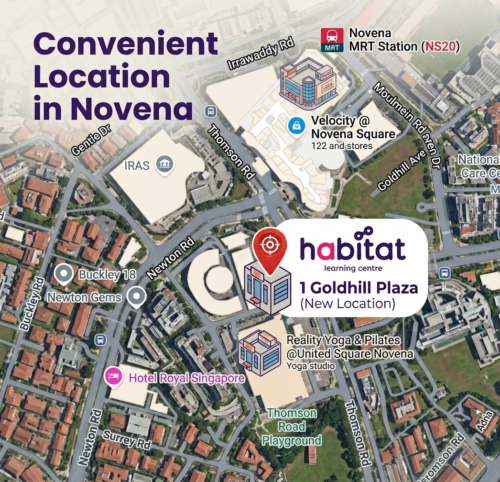
Our primary maths tuition classes are held at Habitat Learning Centre, 1 Goldhill Plaza, #02-27, Singapore 308899 — a 3-minute walk from Novena MRT on the North-South Line (Exit B), near United Square Shopping Mall and Velocity @ Novena Square. We are accessible for families from across central Singapore: Toa Payoh, Bishan, Ang Mo Kio, Thomson, Newton, Orchard, and Marymount.
Many of our primary students also take lower secondary science tuition with us when they reach Sec 1 and 2 — both subjects at the same Novena centre with the same small-class approach. Some primary students also take our Chinese tuition for PSLE preparation. Having multiple subjects at one centre with consistent teachers and a familiar environment makes a meaningful difference to students and parents managing a busy academic schedule.
Primary Math Tuition Fees in Singapore — What to Expect
Here is how primary maths tuition fees in Singapore typically compare across formats, to help you evaluate your options:
| Format |
Lower Primary (P1–P3) |
Upper Primary / PSLE (P4–P6) |
|
Large group classes (10–20 students) |
$15–$25/hour |
$20–$35/hour |
|
Small group (up to 6 students) |
$25–$45/hour |
$30–$55/hour |
| Private 1-to-1 home tuition |
$35–$60/hour |
$40–$80/hour |
|
Habitat (1.5–2 hour sessions) |
WhatsApp for rates | WhatsApp for rates |
Habitat’s small-group model delivers individual attention — not possible in large-group tuition — at a significantly lower cost than private 1-to-1. No administration fees. No full-term advance payment. We collect 4 lessons in advance only.
Words from Math Tuition Students
“I enjoyed my four years here very much. When I first came here, I did not think I would do well in secondary school. This is because I did badly for PSLE. However, after tuition here, I managed to score As for math and science in school. I must thank all the teachers who taught me well and made me understand topics better, especially my current physics and chemistry teachers.
I made very good memories here, and I enjoyed my time here very much”
Some Common Questions for Primary Math Tuition
What primary school levels does Habitat offer maths tuition for?
We offer primary maths tuition from P1 through P6, including dedicated PSLE preparation for P5 and P6. Each level’s programme is aligned to the current MOE primary mathematics syllabus, including the 2026 updates now in full effect for all P1 to P6 students.
What is different about the 2026 PSLE Maths syllabus?
2026 is the first year all P6 students sit the PSLE under the updated MOE syllabus. The most significant changes are: Algebra is newly introduced at P6 (simple linear equations and expressions); Ratio and Average have moved from P5 to P6; Speed has been removed from the primary syllabus entirely. The exam paper itself has also been updated — Paper 1 now carries 50 marks (previously 45) and Paper 2 carries 50 marks (previously 55). Our teaching materials are fully updated to reflect all these changes.
When should my child start primary maths tuition?
For students aiming for AL1 or AL2 at PSLE, we recommend starting structured tuition no later than P4, when topics begin to require proportional reasoning and multi-step problem solving. For students already struggling, starting earlier is better — gaps in P3 number sense and fraction foundations directly affect P5 and P6 performance. The earlier gaps are addressed, the less intensive the intervention needs to be.
My P6 child has less than a year before PSLE. Can Habitat help?
Yes. We regularly take in P6 students at any point in the year. Our aptitude test identifies the highest-priority gaps quickly, and our teachers structure a focused programme that covers remaining content, addresses specific weak areas, and builds PSLE exam technique in the time available. WhatsApp us to discuss your child’s current situation.
What is the model method and do you teach it?
The model method — drawing bar models to represent relationships between quantities — is a core problem-solving strategy in Singapore primary maths and a key tool for PSLE problem sums. We teach it as a flexible reasoning approach, not a fixed template, so students can apply it to unfamiliar problem types. We also cover the full range of PSLE heuristics: working backwards, before-and-after, systematic listing, and make-a-table.
How small are your primary maths classes?
Maximum 6 students per class. This is our standard cap across all levels and is what makes individual review of every student’s working genuinely possible in every session.
Do you provide notes and worksheets?
Yes. All Habitat primary maths materials are written in-house by our teachers and updated to reflect the current MOE syllabus. Notes, worked examples, and worksheets are provided free of charge to enrolled students. We do not use photocopied commercial assessment book pages.
My child is good at maths. Is tuition still beneficial?
Yes — for different reasons. Students who are already performing well benefit from exposure to non-routine problem types and harder problem sums that school teaching rarely reaches in depth. For P6 students aiming for AL1, the difference between a good score and a top score often comes down to speed, accuracy on unfamiliar question types, and exam technique — all of which structured coaching builds deliberately.
Is there a trial class?
Yes. Contact us via WhatsApp to arrange a trial class. No commitment is required.
Start Primary Maths Tuition at Our Singapore Centre Today
Whether your child is in lower primary building foundational number sense, in P5 tackling complex problem sums for the first time, or in P6 preparing for the PSLE under the updated 2026 syllabus, Habitat Learning Centre’s primary maths tuition gives them the structure and individual attention to improve. Small classes. K-D-C methodology. In-house materials. Teachers who stay.
Contact us today to check availability and arrange a trial class. WhatsApp: +65 9795 3323.
We are located at 1 Goldhill Plaza, #02-27, Singapore 308899, right opposite United Square in Novena.
By MRT (Novena Station - NSL):
- Take Exit B and cross the overhead bridge linking Velocity to Goldhill Shopping Centre.
- Cut through the shops toward the distinctive round pink building (Goldhill Plaza).
- Walk up the staircase beside the carpark lift—we are located at #02-27.