
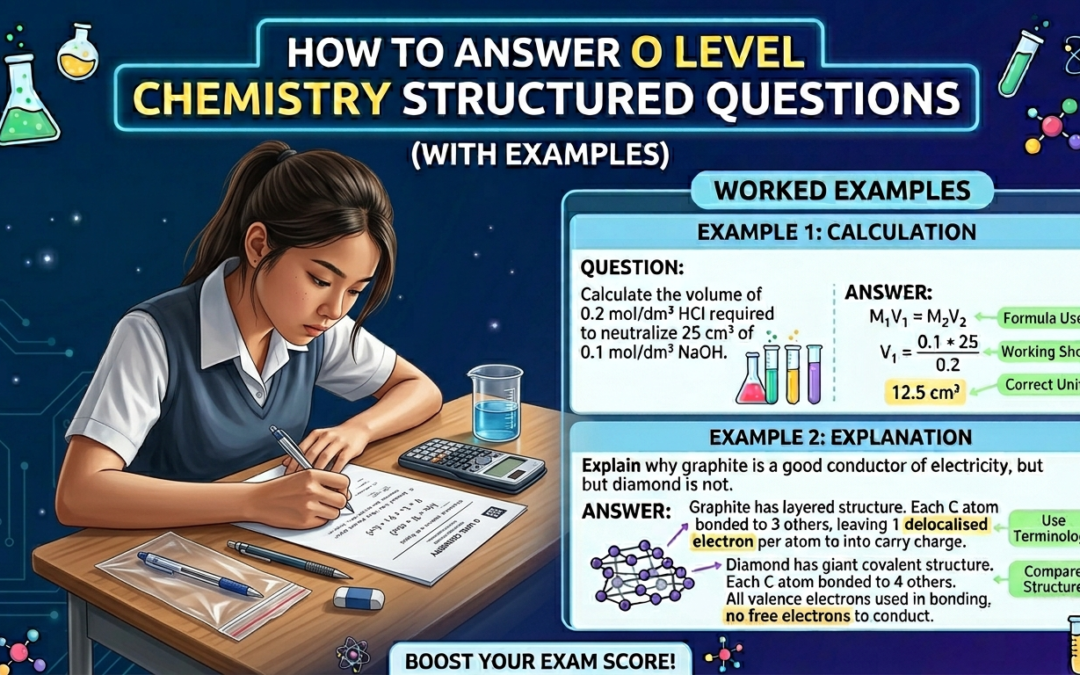
O Level Chemistry structured questions often leave students unsure of how much detail or explanation to include. These questions are designed to test not only your knowledge but also your ability to apply concepts clearly and logically. Mastering this skill requires practice, understanding how questions are asked, and knowing what examiners are truly looking for in your answers. By developing effective O Level Chemistry answering techniques, you can transform your exam performance and approach even the most complex problems with confidence.
Understanding O Level Chemistry Structured Questions Clearly
Before diving into answering techniques, it’s essential to understand the nature of chemistry structured questions. Unlike multiple choice questions, these require written explanations, calculations, or drawing molecular and reaction diagrams. Each part of the question often builds upon the previous one, and marks are distributed for showing your reasoning process. Recognising this structure helps you approach each section logically rather than rushing to the final answer.
A common challenge lies in misinterpreting the verbs used in questions, such as “state,” “explain,” “describe,” or “calculate.” Each of these prompts a different type of response. For instance, “state” may only need a brief factual answer, while “explain” demands the reasoning behind that fact. Understanding question requirements ensures that your answer matches the examiner’s expectations, preventing unnecessary loss of marks.
Moreover, paying attention to how questions are worded offers hidden clues. For example, if a question provides data or a reaction equation, make sure you relate your explanations directly to the information given. Developing a strong awareness of these details strengthens your ability to predict the underlying concepts being tested—an essential step in mastering O Level Chemistry structured questions.
Proven O Level Chemistry Answering Techniques for Success
Applying effective O Level Chemistry answering techniques begins with knowing how to structure your responses. Always plan your answer mentally before writing. Start by identifying the concept the question targets, then organise your explanation step by step. Clarity is key — short, well-structured sentences often earn more marks than long, uncertain ones filled with unnecessary information.
Next, emphasise the use of keywords in chemistry answers. Examiners allocate marks based on these crucial terms that reflect a correct understanding of scientific concepts. For instance, forgetting to include “gain of oxygen” when describing oxidation or “movement of ions” when discussing electrolysis could result in losing valuable points. By memorising and using standard scientific phrases, you maintain consistency in your responses and ensure full recognition of your knowledge.
Equally important is practicing with past-paper questions and timed sessions. Exposure to different question styles helps you identify recurring patterns and areas of weakness. Self-reviewing your mistakes and comparing your answers with examiner reports or marking schemes provides direct insight into what the exam board expects — refining your answering techniques further for maximum effectiveness.
Essential Structured Question Tips and Scoring Strategies
To score well in chemistry structured questions, precision and presentation play significant roles. Make sure your answers are logically organised — label diagrams clearly, show all calculation steps, and underline important terms where appropriate. A well-presented script makes it easier for examiners to award marks for every correct point you make. Clarity often distinguishes a borderline pass from a distinction-level result.
Time management also forms part of essential structured question tips. Many people still have nightmares past adult life because they didn’t have enough time to finish an exam paper. Avoid spending too much time on one question; allocate time according to marks awarded. Typically, a one-mark question needs a single precise point, while a three-mark question expects a sequence of ideas or explanations. Practicing under timed conditions helps you develop a natural rhythm that ensures you complete your paper confidently without rushing at the end.
Lastly, focus on exam-day discipline through effective scoring techniques. Remember to check your units, balance all chemical equations, and review your written answers before submission. Even minor corrections — such as writing the correct state symbols or charge signs — can make a difference in your final grade. With these systematic approaches, you can handle each structured question with clarity, precision, and composure.
Mastering O Level Chemistry structured questions is not just about memorizing facts; it’s about developing sharp analytical thinking and disciplined writing. By understanding how questions are structured, applying effective O Level Chemistry answering techniques, and following practical structured question tips, you can unlock higher marks consistently. Through consistent practice, active review, and attention to keywords, chemistry concepts become clearer and your exam confidence grows — setting you firmly on the path to success.
If you need help in your O level Chemistry, Habitat is here to help. Our experienced and dedicated teachers have experience in improving student’s grades. But do not leave it to a last-minute-thing. While our Secondary 4 Chemistry tuition programme can help you, it is better to lay a foundation early such as having a Secondary 3 Chemistry tuition with us. WhatsApp us at 9795 3323 to book a trial lesson.
Recent Comments